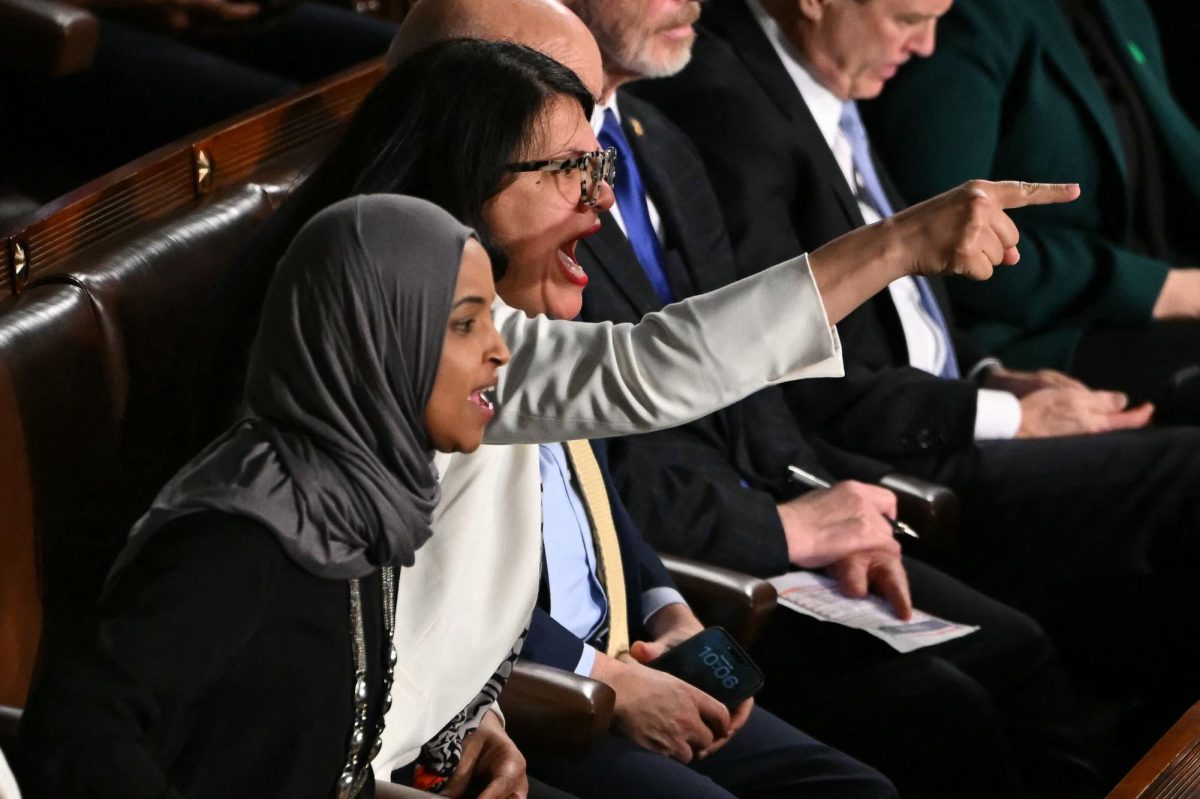
At the February 24th State of the Union address, we were reminded that the President was not the only one without respect for the basic standards of decorum. At one point during the speech, Minnesotan Democratic Rep. Ilhan Omar began shouting at the President from the gallery, visibly furious. “You have killed Americans,” she declared, as Trump gradually raised his voice in response. She was soon joined by another Rep from Michigan, Rashida Tlaib. “Lies!” Tlaib proclaimed, proudly donning a “Fuck ICE” pin. This was months after Minneapolis Mayor Jacob Frey had angrily told ICE to “get the fuck out of Minneapolis” and over a year after Texas Rep Jasmine Crockett referred to Marjorie Taylor Greene as having a “bleach blonde, bad-built, butch body,” (yes, we printed that correctly).
As I watched the State of the Union unfold, I wondered: when did politics get so ugly? You can probably recall the obsessive reportage on Trump’s disregard for political norms and fancy for personal insults when he first arrived on the scene. Even as a 2nd grader in 2016, the constant buzz was inescapable. But after years of this behavior, not only did the public become desensitized to it, so did politicians. By 2020, Trump’s new code of conduct was here to stay. That year, the presidential debate looked like something you’d see in a pub after a football game, and Nancy Pelosi made sure we all saw her gleefully ripping up Trump’s State of the Union while the speech was still underway (unsurprisingly, Pelosi took no issue with Omar’s recent outburst).
Tearing up a piece of paper or screaming at an authority figure is a child’s idea of what an “act of defiance” looks like. Our politicians, indeed our representatives, are supposed to be role models and moral beacons. A decent politician can use effective but respectful rhetoric and make an honest effort to understand their political opponents. This, in turn, allows them to effectively communicate with all of their constituents, not just the ones that already agree with them. At the very least, they can show their respect for the positions above them as well as the one they hold. You don’t yell during a formal address for the same reason you don’t wear a tank top and baggy jeans to a wedding.
These norms should be self-evident. We learn these ideas in Kindergarten. Yet, not only do political norms in the Democratic party continue to disintegrate, our politicians are actively encouraging this conduct and, bizarrely, using Trump’s behavior as justification. The Director of Communications and primary spokesperson for Gavin Newsom (California governor and prospective 2028 Democratic nominee), Izzy Gardon, recently called Nicki Minaj a “stupid hoe” on X after she criticized Newsom, and told a journalist to “fuck off” after she asked a relatively innocuous question about Newsom’s dyslexia. One would hope that Gardon would be fired on the spot, but instead he gets a pat on the back. Bob Salladay, Newsom’s Senior Advisor, explained Gardon’s comments as follows: that “ethos is how we’re fighting Trump … in these appalling times … Izzy’s creativity and imagination is part of what the governor is doing.” It’s worth noting that Gardon is an openly gay man—one can imagine how his “stupid hoe” comment might have gone over differently had this not been the case. Also, “Izzy’s creativity and imagination?” At least Salladay should concede that “fuck off” and “stupid hoe” are jabs of an 8th grade caliber.
I don’t say this to deride Newsom or Democrats generally. The swearing, insulting, and yelling are tactics cemented on both sides of the aisle. As I have noted, it was largely Trump that opened the door for them in the first place. But the “he started it” logic is not a justification. Neither is equating civility and politeness with being docile, as did Renee Graham in her Boston Globe piece “Decorum is the Death of Democracy.” At least the Democrats aren’t a monolith on this matter—Congressman Hakeem Jeffries told his fellow Democrats to either not attend or to sit in “silent defiance” before the 2026 State of the Union. This may not have worked, but he certainly had foresight. All this begs the question: if our leaders can’t disagree with civility, why should the citizens?
This article also appears in our March 2026 print edition.