In 1981, the French philosopher Jean Baudrillard published the “Precession of Simulacra,” in which he argued that our reality was decaying. Whether in the news cycle, politics, or pop culture, he argued that our “images” were gradually becoming self-referential to the point where any connection to the “real” was lost. He called the endpoint of this progression a “simulacrum.” Although he wrote his work long before the internet, nowhere is the “Precession of Simulacra” he described more visible than modern video-sharing platforms.
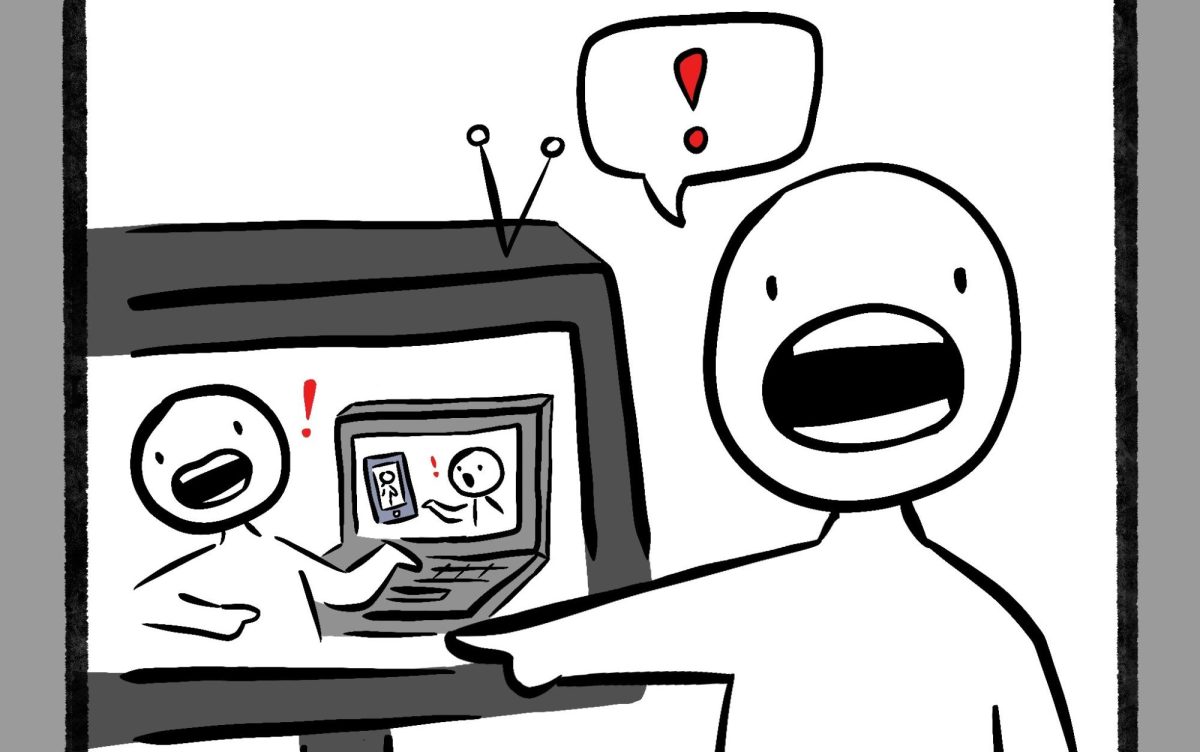
Take the so-called “reaction video.” It’s popular for a reason: it requires little effort to produce, and it offers the user the parasocial experience of watching a video alongside an internet celebrity. Increasingly, it’s become just another strategy in the mass production of content that exists only for the sake of being content. Even a quick search for “low quality reaction video” yields—I kid you not—a guy reacting to a compilation of “low effort reaction videos.” The “original image” the reaction videos might’ve referred to is now lost and any relation to the “real” is gone. It is a simulacrum. And despite its uselessness, this broader trend is something that video-sharing platforms have encouraged.
It was TikTok’s massive success in 2018 that compelled YouTube and Instagram to adopt a similar system, defined by the addictive “infinite scroll” feature. Because the sole focus of the short-form video is to capture the user’s attention and sustain it—often for as little as 10 seconds—creativity is disincentivized, and the “quick hits” are the videos that succeed. This creates a breeding ground for videos that are just cheap amalgamations of preexisting content—like a family guy clip paired with gameplay footage, or a reaction video like the one described above.
But this explosion of sewage content may never have happened were it not for a certain target audience. During the pandemic, parents discovered that a bored or agitated child could be quickly pacified by an iPad. By 2025, over half of children aged four and under had a personal tablet, and time spent on short form content for children aged eight and below had increased 14-fold from 2020. Much of what we consider to be “brainrot” or “sludge” was almost certainly geared, at first, towards this incredibly young audience—but through the power of the algorithm, it can now infect anyone.
Throughout the early 2020s, several varieties of “sludge” emerged—including, of course, the reaction video—but in 2025, the unabashed victor of the low-effort content race was AI slop. Whether it’s a kitten meowing Billie Eilish or a man saving a puppy from drowning in a hurricane, AI slop is the nauseating fever dream of the internet. It’s the perfect exemplification of an online culture that seeks to hold our attention, authenticity be damned. “Slop” could hardly be a better term: AI content is literally the mashed up, regurgitated slurry of the billions of videos and images that have been uploaded throughout the years, force fed to the masses through the gavage tube of short-form content.
This is what Baudrillard called the “Precession of Simulacra.” Copies. Iterations. Iterations of videos, reposted again and again, iterations of people reacting to people reacting to people, iterations of AI images fed back into AI generators that cannibalize themselves into oblivion. The internet becomes its own self-referential bubble, one that people lose themselves in for hours on end, one that kids are raised on. When people become so immersed in these ultra-processed images—simulacra—not only do attention spans shorten, but it becomes harder to interact with the real altogether.
This article also appears in our February 2026 print edition.