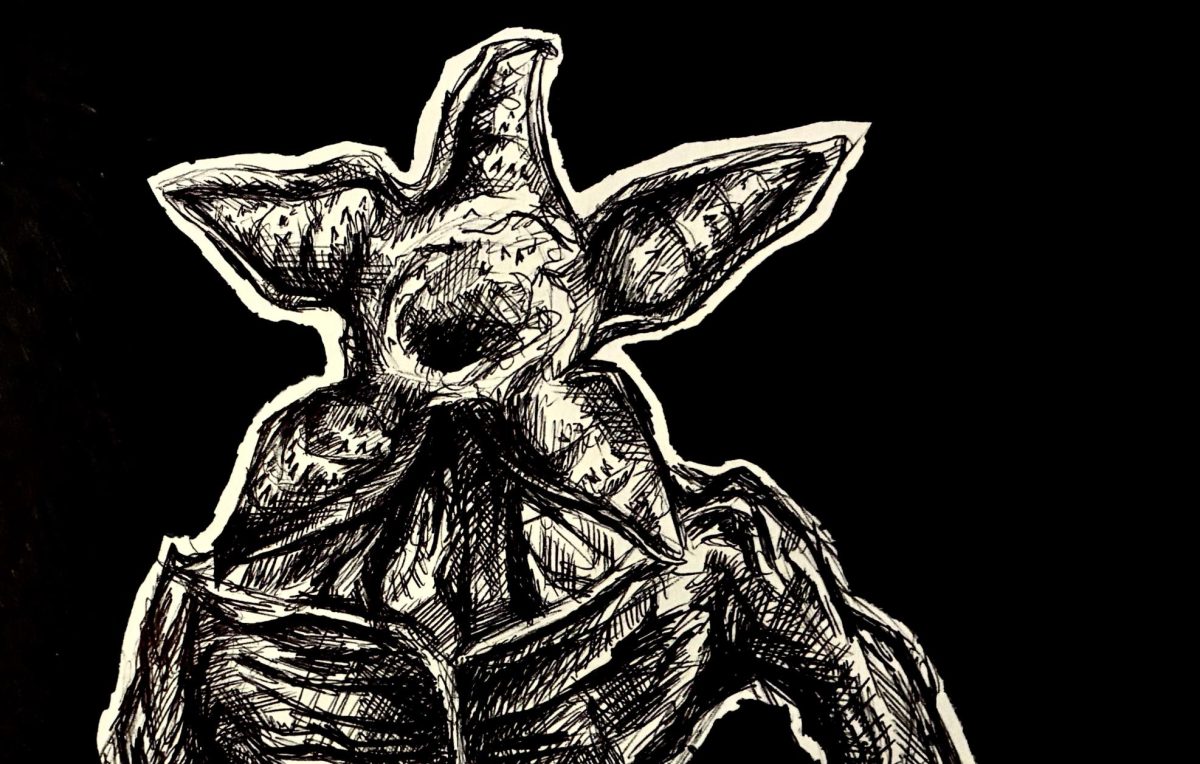
Disclaimer: This article contains spoilers for all five seasons of Stranger Things.
Stranger Things Season Five lacks a soul. To avoid dissatisfying some viewers, the Duffer Brothers designed this season to fulfill the wishes of a wide fanbase but forgot what made the show so remarkable in the first place as a result.
To discuss the failure of the final installment, one has to acknowledge what made the series so popular in the first place. Stranger Things Season One was incredible. It told the story of a family losing their child and the characters had a clear purpose in the narrative: Joyce represented the hopeful mother desperate to cling to the past, while Jonathan was the resigned brother who simply wanted to move on with his life. The character moments flowed naturally because they were directly tied to the central plot of finding Will.
The tone of Season One was also a perfect encapsulation of horror. As the characters slowly pieced together an ever-growing mystery, the audience was left in the dark with questions that kept them watching. It was Season One’s realistic characters and uncertain plot that made it phenomenal. Both aspects were forfeited, however, by the end of Season Five.
As the show went on, the grounded feel of the earlier seasons slowly dissipated as more and more characters were added. None of these characters could have any meaningful character arcs when their screen time was eaten up by the 20 other characters the show was trying to use.
In the fifth season, we get introduced to Holly Wheeler, a character who has shown up perhaps three or four times prior to this. Holly somehow becomes central to the plot with more screen time than the main characters. And as a result, what do the main characters even contribute? Lucas stands around worrying about Max. Will stands around worrying about his sexuality. Jonathan and Steve stand around vying for Nancy’s attention. Mike is there! As for Eleven, Steve, Dustin, Hopper, Robin, Max, Derek, Joyce…..God, how many are there? They….say things, I guess. Or rehash past character arcs. These aren’t the compelling character beats that the show originally was so good at. In their effort to keep all the beloved characters involved, the Duffer Brothers failed to give them any narrative purpose.
Furthermore, the show’s effort to keep all the main characters leads to a lack of stakes. Instead of killing off any of the precious main characters, the creators introduce a beloved side character each season, and kill them off instead. Barbara (S1), Bob (S2), Alexei (S3), and Eddie (S4) were all victims of this brutal slaughter. If a main character is ever presumed to be dead (say, Hopper at the end of Season Three), not to worry! They’ll be back after an unrealistic retcon proving how they survived.
While initially seeming like an easy way to avoid killing off main characters, this strategy eventually becomes formulaic and easily predictable. The Duffer Brothers have proven they aren’t able to commit to a main character’s death, and thus, all the risky situations in Season Five come across as naught but shock value. The characters are never in any danger, so what’s the point in caring? There is never any tension.
What’s more, all the supposedly “tense” moments get resolved within seconds. Whether it’s through intense plot armour where demogorgons are easily destroyed by an irrelevant side character, or a poorly placed emotional scene in which Will has a six-minute long, forced, and unrealistic coming out scene, the tense moments in the show are never really tense at all.
Even the villain, who was once such a pinnacle of tension and ominousness, has been completely watered down. In Stranger Things Season One, the lack of details surrounding the evil added to the ominous feel. However, in Season Five, the entire evil universe is overexplained, and the main villain is given a tragic backstory portraying his victimhood, ruining the pure terror he’d previously ignited. Fans may want answers, sure, but some things are better left unsaid.
The character and tension issues result in an anticlimactic finale and a strangely empty resolution. The (somewhat) evil Vecna gets defeated within five minutes (For goodness’ sake, Will’s coming out scene was longer than that!) And, all 20 or so of the main characters merely stand there during the battle. No one is even harmed. Save for Eleven at least, who, in an emotionally charged moment, decides to sacrifice herself to stop the cycle of creating children with superpowers that led to her existence in the first place. Except maybe she’s not actually dead? We wouldn’t want to risk scaring away the fans who want her to live! Or maybe she is dead? We wouldn’t want to risk scaring away the fans who want her to die!
At the very end of the show, with no meaningful story arcs to complete, the characters sit around being happy for 40 minutes. And thus, with not a bang but rather a gentle thump, the ten-year-long franchise that captured everyone’s hearts for so long finally comes to an end.
All in all, at the end of its journey, Stranger Things isn’t the grounded, character-based story it was in Season One or the high-stakes mystery with immense twists and turns of Season Four. The characters have no clear purpose, and the tone feels forced and lacking. Fans are left vaguely dissatisfied, but the ending gives everyone at least something to be content with. The world moves on, and Stranger Things is slowly forgotten about.
Well….until the next of its kind pops up. Until the next Stranger Things, or Star Wars, or Game of Thrones takes place. Shows that start off very popular and solidly written, but then slowly deteriorate as they fall into the trap of pleasing fans. Because the truth is this: Stranger Things Season Five may be poorly written, but its viewing numbers are still off the charts. Fans are so invested in the show that they don’t care about the quality. All that matters is continuing to watch comfort characters grow, and Netflix can benefit from the guaranteed money nostalgia generates. Stranger Things Season Five is nothing more than a washed-out reiteration of a show that once so clearly had a purpose. And the worst part? It’s working.
This article also appears in our January 2025 print edition.